
Boston Marrow Squash
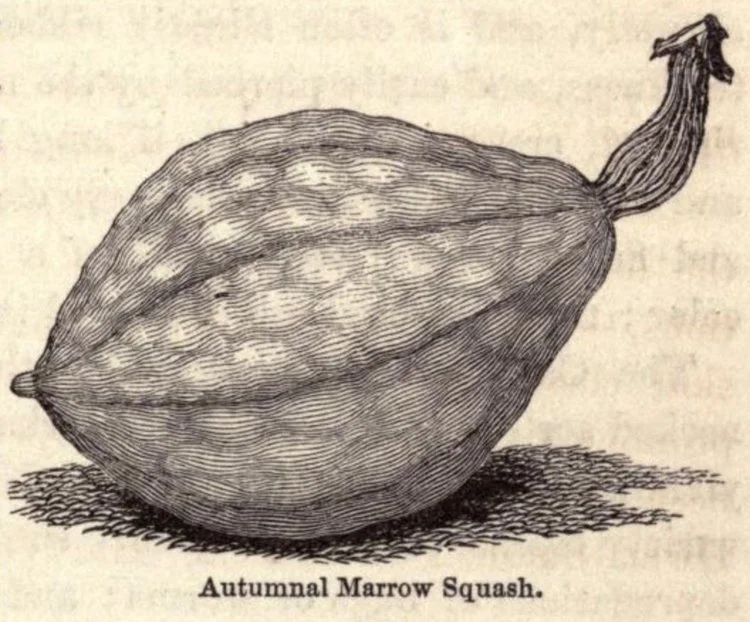
You might recognize the name Boston Marrow (or perhaps even grown it yourself) but that’s all this once-renowned variety really is nowadays: a borrowed name.
The original strain was quite similar to modern-day Potimarron or Red Kuri squash –– small, neckless, and slightly pointed with salmon-pink skin and distinct ribs running end-to-end along its exterior. On the inside, it displayed an exceptionally smooth orange flesh with a standard-setting reputation for flavor.
Following its 1831 introduction to Massachusetts, Boston Marrow (or Autumnal Marrow, as it was initially named) quickly became a fixture of city markets and nearly every farm field south of Salem. No other squash of that era commanded a higher price than Boston Marrow but the years to follow would showcase one of the great ironies of food history; too much success can push a variety to its own extinction.
The species to which this one belongs (Cucurbita maxima) was first introduced to the United States around the 16th century, almost certainly via European whalers returning from the Atlantic coast of South America. Boston Marrow itself is evidence of this, having been brought to Massachusetts from Buffalo, NY –– a thriving maritime port city (and home of Moby-Dick’s Steelkilt for what it’s worth). Whether the squash was well-known to New York growers is uncertain, as the only information we have on this comes to us from John Ives, who is credited for its official introduction to the public.
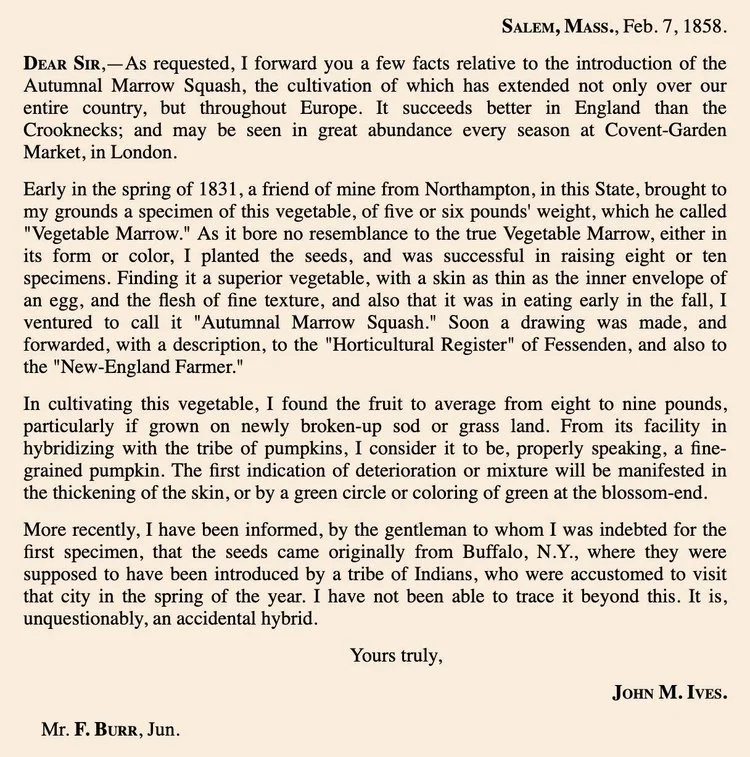
John Ives’ letter to Fearing Burr (1858)
In a letter to Fearing Burr, Ives recounted being gifted his initial specimen by a friend in Northampton, who in turn believed that it was brought to Buffalo by a traveling band of Native Americans (perhaps the Seneca of Ganondagan, if true). The name of this friend was never provided but the prominent Northampton abolitionist William Stoddard is a very likely candidate, given his family ties to Utica and professional relationship with Ives.
One thing seems certain; the people of Massachusetts were willing to pay a hefty price for this new squash and growers happily obliged. With such an alluring price tag, its unsurprising that many farmers viewed Boston Marrow’s small size as lost potential. Bigger isn’t always better but it certainly helps pay the bills when you’re selling veggies by the pound!
Breeding a squash to produce heavier fruit is simple, especially when your starting point is only six pounds. Just plant a larger variety of the same species a few yards away and the bees will take care of the rest. There’s no need to speculate in this instance, thankfully. We know exactly what happened.
In Squashes: How to Grow Them, the famed seedsman James Gregory recounted, “marketmen found that by crossing with the African and South American varieties, they could increase the size of the original Marrow”. Growers didn’t concern themselves with the impact this would have on quality or flavor. Even if they came to regret it, undoing this action is, well… a trickier process to put it mildly.
Over the years, Boston Marrow ballooned in size many times over. Its prominent ribs slowly faded, a long neck began to sprout up from below its stem, and it goes without saying that the fine quality of its flesh deteriorated beyond repair. Gregory even bestowed these hybrids with a name of their own, referring to them collectively as the Cambridge Marrow squash.
Cambridge strains were varied and abundant — sharing very little resemblance with their predecessor and even less with each other — yet all were sold under the good name of Boston Marrow regardless. Consumers surely noticed something was awry but the issue (albeit an intentional one) was never truly corrected.
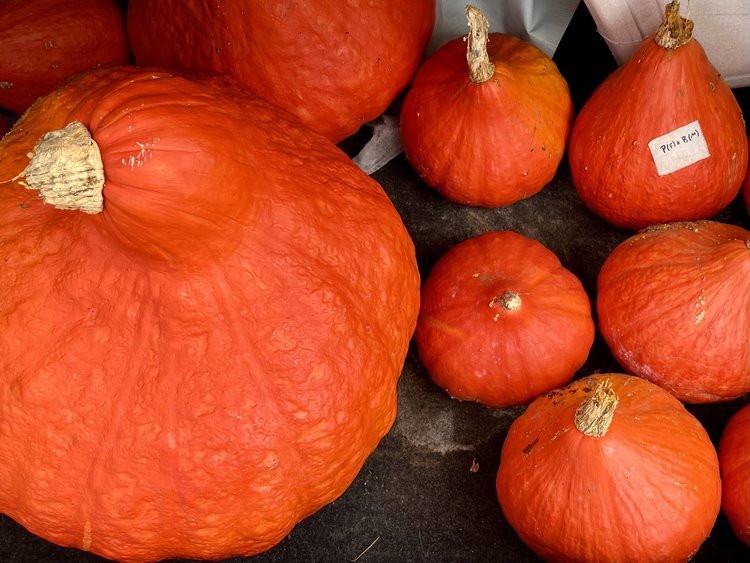
The purest known strain of BM (left) & Potimarron (right).
Today, all so-called Boston Marrow seeds on the market are direct descendants of the hybridized Cambridge types. Even the most authentic known strain is no less than twice the original size. Most modern growers are unaware of this labeling error and can be spared the shame of perpetuating it. Yet, unfortunately, the hybridization of Boston Marrow never truly stopped. Noticeable changes in the size and appearance of this squash have taken place in the last few decades alone, largely a result of accidental crosses going unnoticed by seed savers.
Whether or not the original strain still exists is unknown. Perhaps the Native Americans of upstate New York traded seeds with somebody else’s nameless friend. Or maybe it lives on as a family heirloom with a new name, tucked away in a backyard garden somewhere.
In 2024, we began two multi-year experiments aimed at resurrecting the original Boston Marrow squash. The first method is simple: grow and select the purest strain we have until it matches the characteristics described in the 1800s. The second method is a bit quicker, but admittedly a little ironic: hybridize Boston Marrow (one more time) with Potimarron, then select the offspring until they resemble the original strain.
Time will tell if we’re successful but either way, there’s only one real method to save the Boston Marrow squash of old –– keep your eyes peeled!
Last Grown in 2025